Stonewall by Martin Duberman
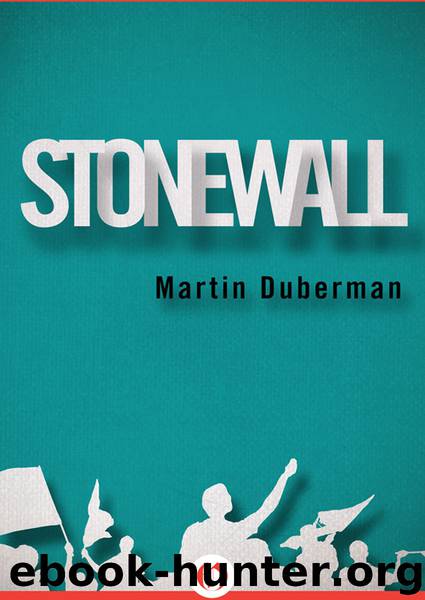
Author:Martin Duberman
Language: eng
Format: epub
Publisher: Open Road Media
JIM
Jim Fouratt regarded Abbie Hoffman as his brother. They had been through a lot together—from the action on the floor of the stock exchange to the confrontation at the Democratic convention in Chicago. And in 1969 they managed to bring the David Susskind television show to a dead stop by unveiling a live duck that promptly shat all over the stage. (Jim had already stunned Susskind by appearing dressed all in white; an apparition, complete with flowing blond hair, that seemed a miraculous reincarnation of Jesus Christ himself.)
Through all the high jinks and the serious politicking, Jim had swallowed his doubts about Abbie—about his self-celebration, his drug-taking, his (in Jim’s view) “irresponsible” tendency to lead people into more trouble than they had bargained for. But an incident finally occurred that crystallized Jim’s doubts and led to a definitive break between the two men. In order to do his political work—to notify and mobilize people for actions through his fly sheet, The Communications Company—Jim had long relied on his trusty Gestetner duplicating machine. One night he returned to his apartment to find the machine gone, apparently stolen. His suspicion immediately focused on Abbie, because of the disagreements the two had recently had over the 1968 Chicago confrontations and Abbie’s dismissive comment that Jim “didn’t really understand politics.”
Jim went straight over to Abbie’s place and confronted him. Abbie didn’t even bother to deny the theft. Instead he acted as if the Gestetner was legitimately his by right of his superior understanding of the requirements of political organizing. Deeply wounded—“I would have died for Abbie”—Jim gave up the contest in despair, reluctantly concluding that he could never again trust Abbie, could never believe in his ability to put loyalty to a friend above the presumed exigencies of politics.
Ever the moralist, Jim decided there was a lesson to be learned: “not to endow people with what I want them to be, but to try to see them as they are so that I’m not set up to be disappointed or destroyed.” But like anyone with a good heart and a large capacity for trust, Jim would have to learn that lesson over and over. Fortunately, he never learned it for long—fortunately, because an optimistic sense of the “goodness” of human nature is always the essential fuel for activism.
But for the moment, hurt and confused, Jim retreated from the movement. He went out to San Francisco for three months with his lover, Howie, and took up weaving—the hippie alternative to confrontational politics. But weaving turned out not to be “it” after all—“I was bored out of my mind”—and early in 1969 Jim was back in New York, where he dabbled for a time in that other hippie alternative, drugs. Give or take an occasional puff, Jim had previously avoided drugs, but now he started going regularly to the Sutton Place office of “Dr. Feelgood” (John Bishop). There, assorted celebrities crowded the waiting room for their “vitamin” shots (“Amphetamines? Well, of course not!” Dr. Feelgood would reassure those patients determined to be gullible).
Download
This site does not store any files on its server. We only index and link to content provided by other sites. Please contact the content providers to delete copyright contents if any and email us, we'll remove relevant links or contents immediately.
| Africa | Americas |
| Arctic & Antarctica | Asia |
| Australia & Oceania | Europe |
| Middle East | Russia |
| United States | World |
| Ancient Civilizations | Military |
| Historical Study & Educational Resources |
Cat's cradle by Kurt Vonnegut(15441)
Pimp by Iceberg Slim(14662)
4 3 2 1: A Novel by Paul Auster(12505)
Underground: A Human History of the Worlds Beneath Our Feet by Will Hunt(12144)
The Radium Girls by Kate Moore(12089)
Wiseguy by Nicholas Pileggi(5841)
The Fire Next Time by James Baldwin(5501)
Perfect Rhythm by Jae(5460)
American History Stories, Volume III (Yesterday's Classics) by Pratt Mara L(5337)
Paper Towns by Green John(5247)
Pale Blue Dot by Carl Sagan(5076)
A Higher Loyalty: Truth, Lies, and Leadership by James Comey(5017)
The Mayflower and the Pilgrims' New World by Nathaniel Philbrick(4540)
The Doomsday Machine by Daniel Ellsberg(4538)
Killers of the Flower Moon: The Osage Murders and the Birth of the FBI by David Grann(4488)
The Sympathizer by Viet Thanh Nguyen(4440)
Too Much and Not the Mood by Durga Chew-Bose(4386)
The Borden Murders by Sarah Miller(4375)
Sticky Fingers by Joe Hagan(4253)
